Read this in 한국어.
LLM Wiki Newsroom is an open-source framework that turns a folder of documents into a cross-linked, human-readable markdown wiki, maintained by an AI agent organized as a five-role newsroom. Drop articles, notes, and PDFs into a folder, run one command, and the agent — powered by Claude Code — reads them, extracts entities, concepts, and relationships, and organizes everything into interlinked pages. It’s a persistent, structured alternative to RAG. Unlike most takes on the idea, the agent that writes a page is never the one that reviews it, and the authoring guidelines evolve themselves over time. It’s harness engineering applied to knowledge production rather than code — with one more loop than the coding version needs, because a wiki page goes stale on its own.
View on GitHub » Read the FAQ »
See the output before installing
The example corpus shipped in the repo — the debate over what “open source” means for AI — is published as a browsable GitHub Wiki, so you can read the generated pages without cloning. The interactive knowledge graph below runs locally after you clone.
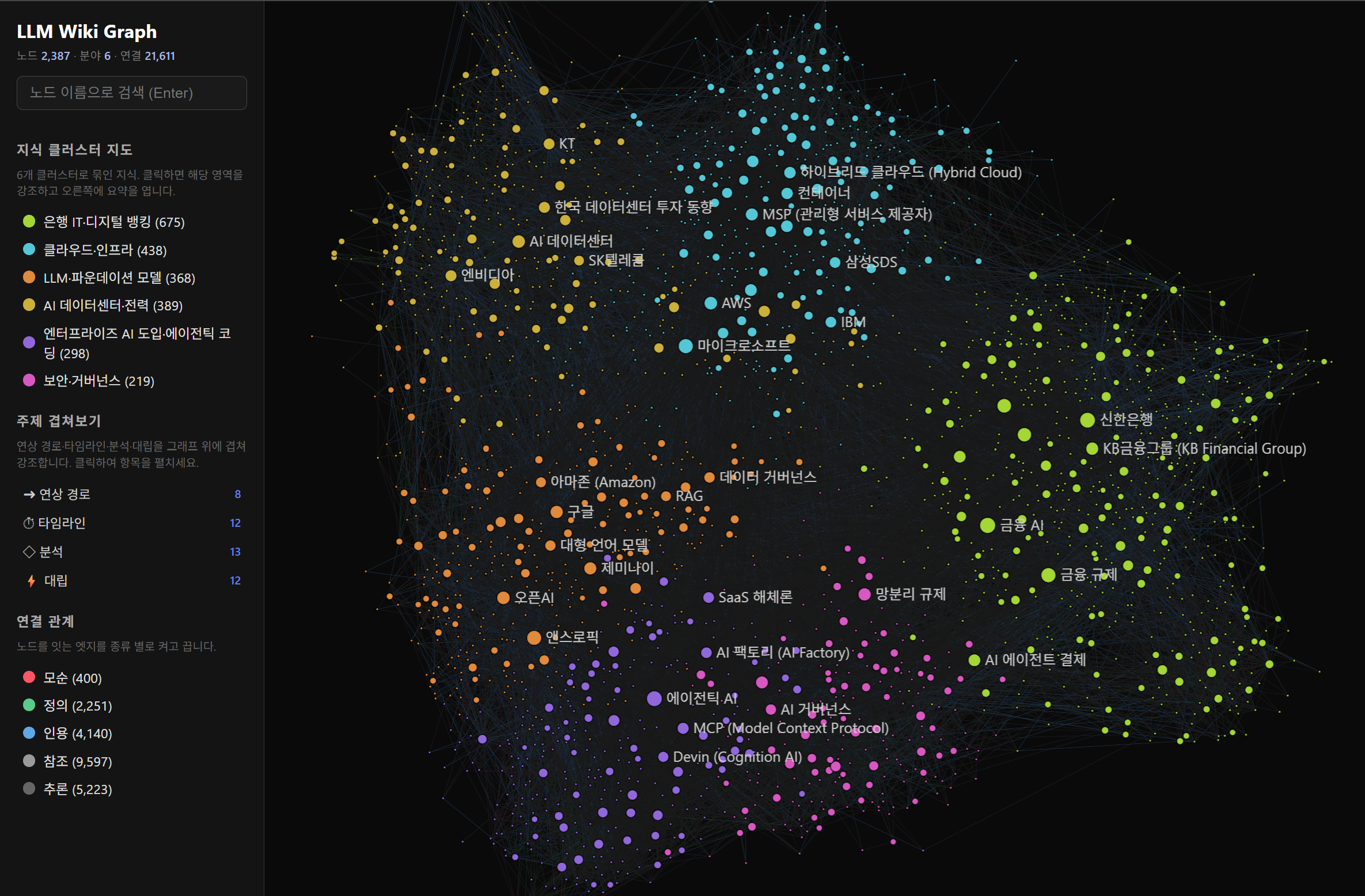
The interactive graph (graph/graph.html) — every page a node, every wikilink an edge, color-coded by auto-detected cluster, with a live physics layout and filter/search built in. Shown on a larger private deployment (~2,300 nodes) to convey how it scales; this repo ships a deliberately small 15-node example corpus you browse the exact same way.
What makes it different
It keeps the three-layer shape of Karpathy’s LLM Wiki — raw/ for untouched sources, wiki/ for the pages the agent maintains, and a schema layer holding the operating rules — plus the same three operations: ingest, query, and lint. There are plenty of takes on that idea now; after reading the popular implementations, four things here are genuinely rare:
- Authoring guidelines that evolve themselves. When the same review failure keeps recurring, the system drafts a fix to its own writing rules and keeps it only if a blind A/B against a rotating regression set shows it actually helped. So it isn’t only the wiki that improves over time, but the rules that build it. (Still experimental — the author is measuring whether it earns its keep rather than claiming it’s solved.)
- A full newsroom, not just “an agent.” The work is split across five roles — a reporter drafts source pages, a columnist writes the deep cross-source analysis, a desk editor re-reads it for bias, argument quality, and narrative flow, a copy editor runs deterministic checks, and an editor-in-chief routes work and gates publication. Not every seat is a model passing judgment: the desk holds the only independent LLM verdict, the copy editor is a Python script, and the rest is writing work or orchestration. The reviewer sees only the draft and the rubric, never the writer’s reasoning — the real lever is context isolation, not instance count.
- Memex-style associative discovery. Saved reading trails and “unexpected connection” surfacing, inspired by Vannevar Bush’s Memex (1945), that the other implementations don’t carry.
- A loop for knowledge going stale. Shipped code stays correct until the spec changes; a wiki page goes wrong on its own as the world moves on. So published pages come back around as input — when their sources change, when a claim’s own deadline matures, or when two pages start contradicting each other. The three loops an AI-coding harness runs on don’t cover that, which is why there’s a fourth here. (The full argument is in The Knowledge Factory.)
Nothing reaches the wiki until it clears both gates:
| Gate | Who | What it checks | How |
|---|---|---|---|
| 1 | copy editor | links, citations, structure | deterministic — tools/lint.py, a Python script, not a model |
| 2 | desk | bias, argument quality, narrative flow | qualitative — a fresh-context review against an editorial rubric |
Machine-checkable things are checked by machine; only what needs judgment costs a model call.
The rest — the knowledge graph, contradiction tracking, cascading updates, plain-markdown/Obsidian output — many LLM-wiki tools have in some form. The self-evolving guidelines, the five-role newsroom with its rubric, the Memex discovery, and the reground loop are the bet.
How it compares to RAG
| RAG | LLM Wiki Newsroom | |
|---|---|---|
| Knowledge state | re-extracted per query | organized once, continuously updated |
| Retrieval unit | source chunk | structured wiki page |
| Cross-reference | none | wikilinks + backlink index |
| Contradiction handling | may surface at query time | flagged at ingest time + tracked |
| Accumulation effect | none | new sources enrich existing pages |
| Exploration | keyword search | graph traversal + associative trails |
To be precise, this doesn’t do away with retrieval. Karpathy framed the wiki as a compile step for knowledge, not as a replacement for search, and the optional local search used here is itself a BM25 + vector hybrid. What changes is what gets retrieved: a few already-structured, cross-referenced pages instead of raw chunks reassembled from scratch on every query.
There is now independent, benchmarked evidence for this shape: a WeChat/Tencent team built the same idea — sources compiled into an interlinked wiki that an agent traverses — and reports it beating dense-RAG and graph-RAG baselines on three multi-hop QA benchmarks (“Retrieval as Reasoning”, arXiv:2605.25480). Their numbers describe their system, not this one — convergent evidence for the approach, not a measurement of this repo.
Highlights
- Persistent, plain-markdown knowledge base — your “second brain” as version-controlled
.mdfiles, not a vendor silo. Doubles as an Obsidian vault. - Cascading updates — ingesting one document refreshes ~10–15 related existing pages automatically.
- Contradiction tracking — conflicting claims between sources are flagged at ingest time, not query time.
- Interactive knowledge graph — every page a node, every link an edge, auto-clustered and browsable.
- Associative discovery (Memex) — follow connected concepts to surface unexpected relationships.
- Local-first — the Python tools (graph, lint, search) run entirely on your machine with no API keys; the agent itself runs on Claude Code.
When the split earns its cost
A separate reviewer costs more tokens and more wall-clock than letting one agent grade its own draft. That trade isn’t always worth it:
- One agent is enough when the output is quick and disposable, and a mistake costs nothing to throw away — a scratch summary, a one-off answer. Self-critique in the same context will do.
- Separate the writer from the reviewer when the output is published, accumulates, and gets built on later — where a plausible-but-wrong page quietly hardens into the thing everything else cites.
A wiki is the second case by construction: today’s page is tomorrow’s input, so an error doesn’t stay one error. That’s the bet here, and why this spends the extra tokens.
Where it stands
- New. The repository went public on 2026-06-26. Treat it as the idea plus a small reproducible example, not a battle-tested product.
- The shipped corpus is deliberately small — 15 pages on the open-source-AI debate. The graph screenshot above comes from a larger private instance (~2,300 nodes), shown for scale; that one you can’t verify from the repo.
- The differentiators are hypotheses. Writer–reviewer separation and the self-evolving loop are argued from design, not from published A/B numbers. They’re being measured, not claimed as settled. The newest mechanism — a ladder governing how much the writer reads before drafting — ships with provisional stopping rules and no measurements yet.
- “No API keys” covers the tooling, not the agent. Build, lint, and search are local Python; the reading and writing happen through your own Claude Code access.
- Korean mode localizes prose, not schema.
WIKI_LANG=kotranslates body text and field values; the frontmatter keys and section headers the tools parse stay English, and the shipped example corpus is English throughout.
Quick start
git clone https://github.com/alfadur7/llm-wiki-newsroom.git
cd llm-wiki-newsroom
Or click “Use this template” to scaffold your own wiki repo. Then ingest your own sources with /wiki-ingest. Full setup, all nine slash commands, and the architecture are in the README.
Learn more
- Full README — install, commands, architecture, feature reference
- FAQ — common questions answered
- The Knowledge Factory — the four-loop production system behind the newsroom, from the concept down to the implementation
- Browsable example wiki — the shipped corpus, no clone needed
- Karpathy’s original LLM Wiki gist — the design inspiration
MIT-licensed. A structured, local-first take on the LLM Wiki pattern — built and maintained in the open.